
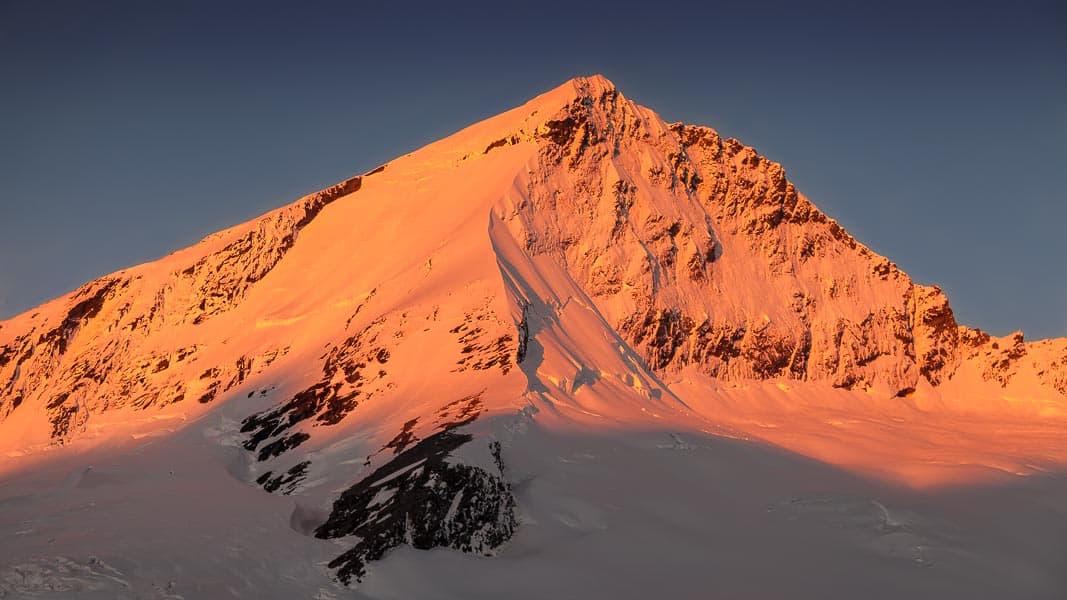
"The 'guide-book' mentality is no substitute for trusting your own judgement and knowing what you are and are not capable of. In the end it comes down to reading the mountains, not the book." — Hugh Logan
The Frost Grading System — New Zealand
Until one or two generations ago, mountaineering routes in New Zealand were not graded. The original system, devised by Hugh Logan in his 1982 The Mt Cook Guidebook, used a single number from 1–7. In 2018, Rob Frost's revised guidebook introduced a two-tiered system that better captures the unique challenges of New Zealand alpine climbing.
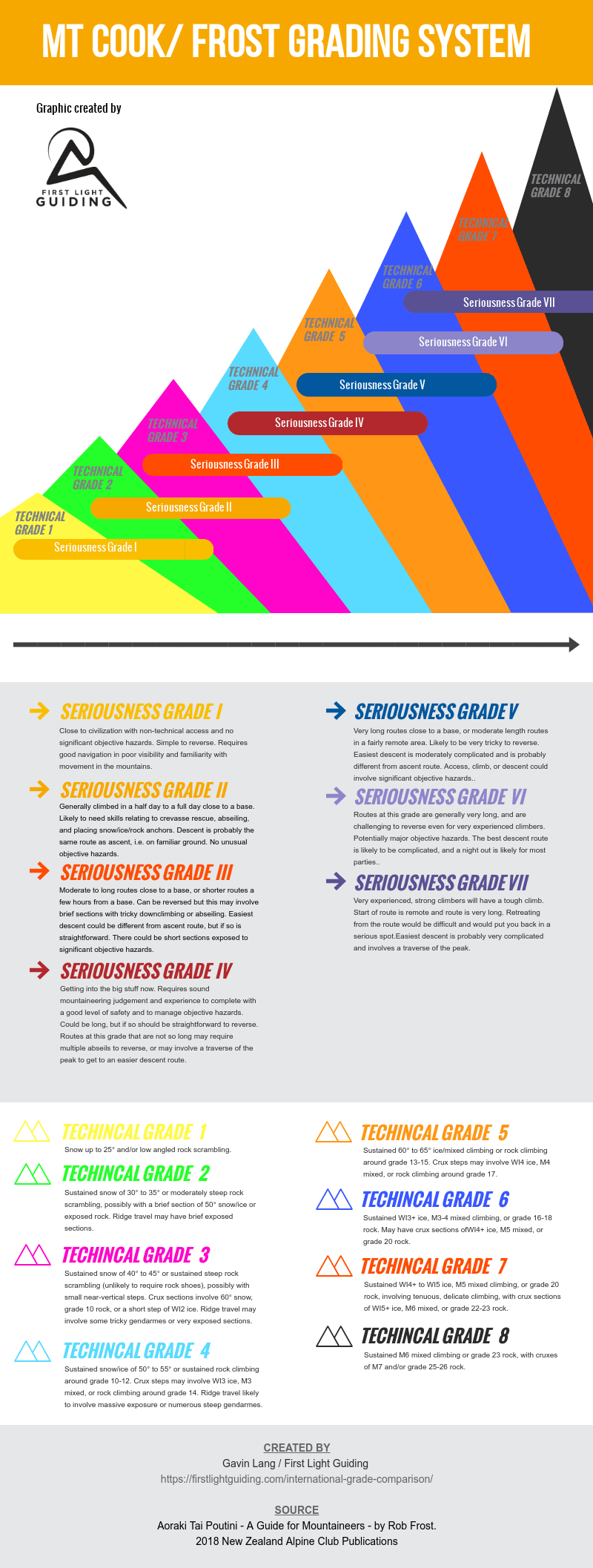
The Seriousness Grade (I–VII)
The most important grade from an overall mountaineering perspective. Takes into account objective hazards, ease of retreat, route-finding demands, length, and descent complexity.
- I — Close to civilisation, non-technical access, no significant objective hazards. Requires good navigation.
- II — Half day to full day close to a base. Needs crevasse rescue, abseiling, and anchor placement skills.
- III — Moderate to long routes close to a base. Can be reversed but may involve tricky downclimbing. Short sections with significant objective hazards possible.
- IV — Requires sound mountaineering judgement. Could be long with complex descent. Significant objective hazards must be managed.
- V — Very long or remote routes. Likely tricky to reverse. Major objective hazards possible.
- VI — Very long routes, challenging to reverse. Night out likely. Potentially major objective hazards.
- VII — Remote, very long. Retreating is extremely difficult. Very complicated descent.
The Technical Grade (1–8)
Takes into account the difficulty of the actual climbing moves — both the crux and how sustained the route is. A '+' symbol indicates greater difficulty.
- 1 — Snow up to 25° and/or low-angled rock scrambling.
- 2 — Sustained snow 30–35° or moderately steep rock scrambling, brief sections of 50° snow/ice.
- 3 — Sustained snow 40–45°. Crux sections involve 60° snow, grade 10 rock, or short WI2 ice.
- 4 — Sustained 50–55° snow/ice or rock around grade 10–12. Crux steps may involve WI3, M3, or grade 14 rock.
- 5 — Sustained 60–65° ice/mixed or rock around grade 13–15. Crux: WI4, M4, or grade 17 rock.
- 6 — Sustained WI3+ ice, M3–4, or grade 16–18 rock. Crux: WI4+, M5, or grade 20.
- 7 — Sustained WI4–WI5, M5, or grade 20 rock. Crux: WI5+, M6, or grade 22–23.
- 8 — Sustained M6 or grade 23. Crux: M7+ or grade 25–26.
Old Mt Cook / Logan Grading System
The original NZ grading system uses grades 1–7 with + and – variations. Easier grades tend to be harder than expected compared to French grades — the challenge often comes from fluctuating maritime climate and long approaches. As a result, upper grades may be slightly easier technically than equivalent French grades.
- Grade 1 — Easy scramble. Rope generally used only for glacier travel.
- Grade 2 — Steeper, trickier sections may need a rope.
- Grade 3 — Longer, steeper sections. Technical equipment necessary. Ice climbs may require two tools.
- Grade 4 — Technical climbing. Knowledge of placing ice and rock gear quickly essential. Involves a long day.
- Grade 5 — Sustained technical climbing. May have vertical sections of ice.
- Grade 6 — Multiple crux sections. Vertical ice may have inadequate protection. May require a bivvy.
- Grade 7 — Vertical ice/rock with possible inadequate protection. Remote area. Bivvy may be required.
International Grade Comparison Chart
Note: These comparisons are approximate. The two-tiered Frost system does not align perfectly with single-number international systems.
| NZ (Logan) | French Alpine | NCCS (USA) | Description |
|---|---|---|---|
| NZ 1 | F (Facile) | Class 1–2 | Easy glacier travel, minimal technical climbing |
| NZ 1+ | PD- (Peu Difficile) | Class 3 | Simple snow/ice with sections requiring crampons |
| NZ 2 | PD / PD+ | Class 3–4 | Steeper snow and basic glacier terrain |
| NZ 2+ | AD- (Assez Difficile) | Class 4 | Moderate snow/ice, some technical sections |
| NZ 3 | AD / AD+ | Class 5 (low) | Technical snow, ice, and mixed terrain |
| NZ 3+ | D- (Difficile) | Class 5 (mid) | Sustained technical, multi-pitch commitment |
| NZ 4 | D / D+ | Class 5 (high) | Serious technical route, commitment required |
| NZ 4+ | TD (Très Difficile) | Class 5.10+ | Very difficult, sustained technical climbing |
| NZ 5 | TD / ED | Class 5.11+ | Extreme difficulty, high commitment |
| NZ 6+ | ED (Extrêmement Difficile) | Class 5.13+ | Top end technical mountaineering |
Understanding grades takes time and experience. The best approach is to build your skill set from the ground up — start with grade I/1 climbs and develop a feel for what each grade means through direct experience. Read more about choosing the right expedition →