
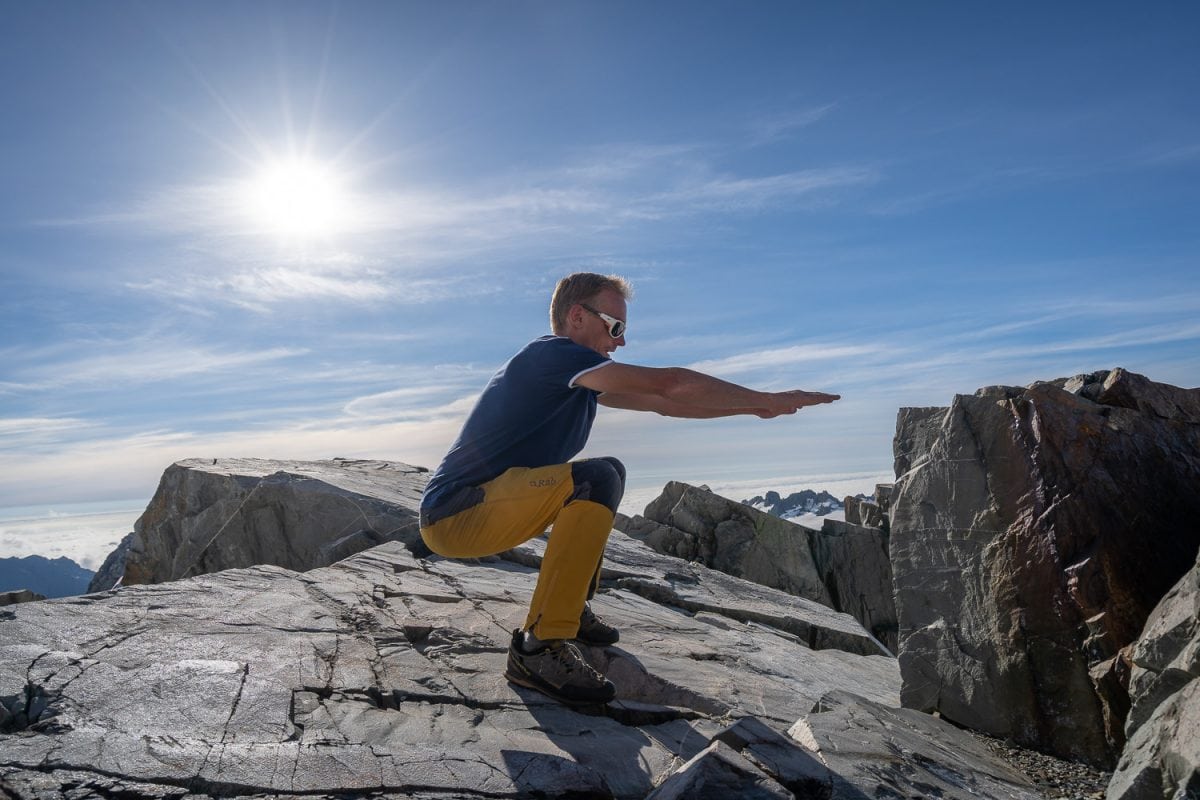
Gone are the days when mountaineers would roll out of bed, drink some hot whiskey, and climb. Okay, I’ll admit most climbers & mountaineers never did that. But back in the day, the concept of a structured warmup and core training programme before a climb was relatively foreign.
Today we know better. A strong core is the foundation of everything you do on the mountain — it stabilises your body on uneven terrain, protects your spine under load, and allows efficient energy transfer from your legs through to your ice axe.
Why Core Strength Matters for Mountaineering
Mountaineering demands sustained effort over many hours, often in challenging conditions. Your core connects your upper and lower body, and without it working efficiently, energy leaks from your system. A weak core also increases the risk of injury — particularly to your lower back and hips — when carrying a heavy pack.
The 9 Exercises
1. Dead Bug
Lie on your back, arms extended toward the ceiling, knees at 90 degrees. Slowly lower one arm overhead while extending the opposite leg. Return and alternate. This exercise teaches anti-extension — essential for controlling a heavy pack on steep terrain.
2. Plank (and Variations)
The classic. Hold a rigid plank for 30-60 seconds. Progressions include: single-arm plank, plank with shoulder taps, and RKC plank (actively squeeze glutes, quads, and grip the floor).
3. Pallof Press
Using a resistance band anchored to a post, press the band straight out from your chest and hold. This trains anti-rotation — critical for traversing across steep slopes.
4. Bird Dog
On hands and knees, extend one arm and the opposite leg simultaneously. Hold 2-3 seconds, lower, and alternate. Great for lumbar stability and balance.
5. Kettlebell Swing
A full-body power exercise that builds the posterior chain — glutes, hamstrings, and lower back. Start light and focus on the hip hinge pattern.
6. Goblet Squat
Holding a kettlebell or dumbbell at your chest, squat deeply. This trains quad, glute, and core strength simultaneously, and improves hip mobility needed for high steps on the mountain.
7. Suitcase Carry
Pick up a kettlebell in one hand and walk. Keep your torso upright and resist the temptation to lean. This directly mimics carrying an uneven load — which is exactly what you do when traversing with a pack.
8. Mountain Climbers
In a push-up position, drive your knees alternately toward your chest in a running motion. Excellent cardio and core challenge.
9. Hip Flexor Stretch / Hip 90-90
Tight hip flexors limit stride length on steep terrain and can cause lower back pain under load. Spend 2-3 minutes per side in a deep hip flexor stretch before and after training.
Building Your Programme
Perform these exercises 3x per week, ideally on non-consecutive days. Start with 2-3 sets of each, progressing to 4 sets as you get stronger. Always warmup with 5-10 minutes of easy movement before starting.
For mountaineering-specific fitness preparation, see the Peak Fitness — Physical Conditioning for Mountaineers guide.